
15 September 2026
Poems, Science and why STEM should be STEAM
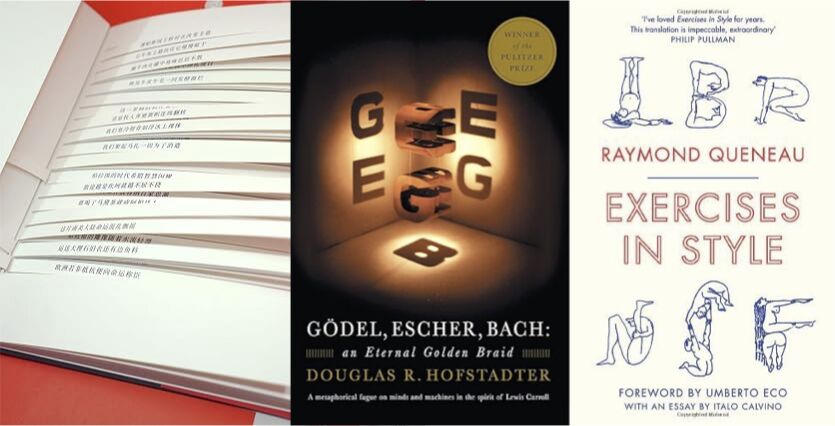
While browsing through my desk, I came across the “Cent mille milliards de poèmes” van Raymond Queneau. Just 10 pages with 14 lines. They can be combined in any order and you have 10^14 combinations. If you allow 45 seconds to read a sonnet and 15 seconds to change the panels, working 8 hours a day, 200 days a year, read all day long, 365 days a year, it comes to 190_258_751 years plus a few odds and ends…
To see and play for yourself with the Cent mille milliards de poemes I created a Queneau Poems Machine that mimics the book.
Queneau combined literature with structure and math in his work. Another literary experiment is “Exercises in Style”, a story about a bus ride. It uses grammatical styles, tones, and perspectives in ninety-nine completely different ways.
This triggered me to see if my long time hero Douglas Hofstadter made references to Queneau in G.E.B. as metaphorical, consciousness, translation, and patterns are the red line in Hofstadter’s work. It did not. However, reading up on the subject revealed that Hofstadter’s “Le Ton Beau de Marot” touches the subject. He translates a single, short 28-line French poem dozens of different ways—in diverse tones, meters, and structures—to see how form alters meaning, continuing “Exercises in Style”…
Having the Arts in STEM balances what science and technology measure against what the arts make meaningful: the difference between a system that functions and one that resonates.
Notes:
STE(A)M is often referred to what we call in the Netherlands 21th Century Skills. It reads Science, Technology, Engineering, (Arts) and Mathematics.
G.E.B. “Gödel, Escher, Bach; An Eternal Golden Braid” - by Douglas Hofstadter
Le Ton Beau de Marot: Article